
Who rides a WorkCycles city bike?

Posted 26 November 2009 | Filed under Bicycling, City bikes, Portland

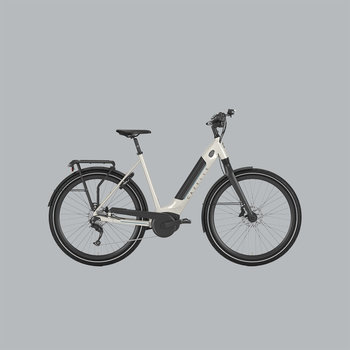
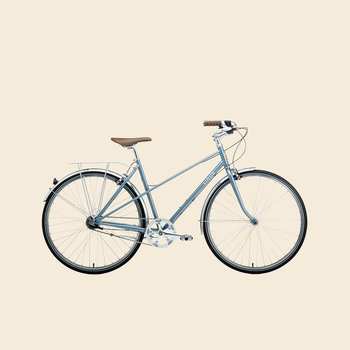
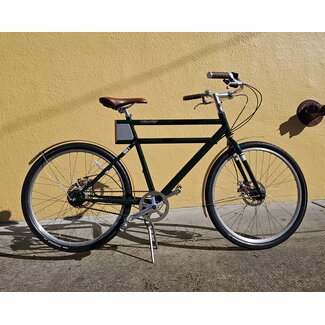
WorkCycles is an Amsterdam company founded by Brooklyn-born Henry Cutler. To date, Henry has exported nearly all of the Dutch bicycles we’ve introduced to Portland, including the conspicuous Bakfiets Cargobike, but also a “Classic” series of city bikes. These are the finest examples of their type, a rarity in North America but the very soul of everyday Dutch biking sensibility. Timelessly beautiful and frankly heavy, what these hard-working tools may lack in miles per hour, they make up in miles per year (MPY) by being so capable, versatile, comfortable, and low maintenance. Miles per lifetime? According to Eric Kamphof, “The average Amsterdammer leaves their bike outside year round, rarely tunes it, and rides it nearly 3000 miles a year. The average age of a bike in Amsterdam is nearly 35 years old.” Meanwhile, WorkCycles city bikes are built and equipped quite a bit better than the average Amsterdammer’s best bike: they are “forever” bikes.

This is Zuzana on her Oma, our most popular bike in this range. Its exceptionally tall head tube permits mounting of a very large basket on the “Pickup” rack fixed to the frame up front, without the bars colliding with the basket. Zuz reports that she rides her Oma faster, further, and more often than the less substantial Electra Amsterdam “Classic” that first whet her appetite for Dutch-style riding.

Zuz’s husband Bryan rides an Opa fit with the same front rack and a shorter box of his own construction. Bryan also races cyclocross. Some people suppose that utility bikes have no sporting appeal. We suppose they offer sporting bikers a more regular workout, weaving “training” into daily errands by replacing car trips instead of subtracting from leisure time. Same goes for non-sporting bikers!

For their two children, Bryan and Zuz rock a Bakfiets.

This is Cedric Justice: Energy Efficiency & Greenhouse Gas Management Consultant. Cedric rides a 65cm Kruis. At 6′5″ and 300lbs, Cedric has a history of destroying bikes. We’d be lying if we denied he’d deformed even the steel cranks of this bike once! This early 20th-century frame design, exuding steampunk flair, is the strongest and stiffest in this line, ample not only to withstand him but also Victorian picnic lunches and environmental monitoring and analysis equipment on both front and rear racks.

Cedric rides with an English equestrian helmet over his cerulean locks because, he explains, nothing else goes so well with an Ascot. He enjoys catching up with cars and faster bikes at every single stop on his commute.

This is Lisa, who with her husband Nathan were among our first Oma & Opa couple customers. Each time they ride off together we remark how badly we wish we had a camera ready: it’s love and elegance on wheels.

Lisa says all that needs saying:

My Oma has changed my bike riding for the better. I ride much more often, and in all seasons. I feel safer, even though I no longer wear a helmet. Sitting upright I am more visible to cars. I can carry much more cargo on my Oma than my previous bike, without feeling like I am compromising stability.

It’s not unusual for motorists or pedestrians to smile at me. I’m never sure if it is wistful envy or curious bemusement. Which reminds me of an incident last summer…

As I rode up Clinton St. one day a young woman sang out the theme for Miss Crump in The Wizard of Oz, as she speeds towards Dorothy’s house to take Toto. Without too much hesitation I assured her “I’ll get you my pretty, and your little dog too.” And we laaaaaaaughed!

This is Sandra and her daughter Nadia Del Pasqua. Sandra is a doula, postpartum caregiver and personal trainer. So many bikers — new mothers especially — don’t survive the transition from a “commuter” model of biking to the “minivan” model imposed by parenthood. We’re grateful to Sandra for her example.

She writes:

Instead of buying a second car, we decided to buy me a bike. I honestly feel like a queen riding the Oma around. Seriously, there are times when I just want to wave to strangers….and I think they feel the same way. People seem to love to see Nadia riding up front.

I also feel like I’m riding a work of art. The bike is so beautifully made and glides – except when I hit the hills and well then I look really good walking beside it. :)

We use this bike all the time to do our grocery shopping, get to our doctor appointments and to the gym. I’m excited to see how she does in the winter!

[Hint: she'll do fine!]

This is Beth, an actual Grandma (Oma) riding a bike of the same name.

Beth is 78. She’s been riding her whole life, in recent decades the US norm of mountain bikes and hybrids mongrelized to pass tenuously as city bikes. She stopped by our shop to ask only about a basket, but with a little encouragement she gave an Oma a turn around the block. “Where have you been all my life?!” her face said upon her return. A few days later she hauled it off on the back of her vintage Volvo.

We’ve seen Beth tooling around the neighborhoods and at the market since, with the same joyous gleam on her face of making up for lost time.

This just in via Henry’s blog: who else? Paul Steely White, New York City bicycle advocate, rides a Workcycles Opa:

Who rides a Brompton?

Posted 29 October 2009 | Filed under Folding bikes

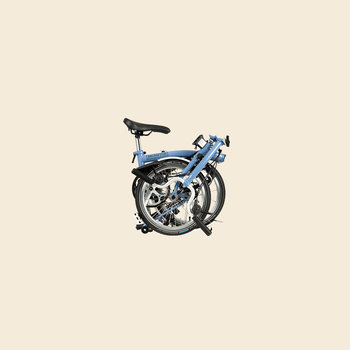
We are proud to have introduced Brompton folding bikes to Portland on the day we opened, having used them ourselves for nearly a decade. They are the single most common riding choice of our shop’s four partners, even when no folding will be necessary. We’ve since carried two other folding bike brands, but stopped after a time because they didn’t sell well alongside Bromptons. We think this is because Bromptons are simply the best, at least for the kinds of people our shop attracts. That’s all kinds of people.

This is Daniel. He’s from Mexico City, and a janitor by trade. He works nights on the west end of the Portland metropolitan area, and lives on the east end. He needed a way to travel the distance between the nearest public transit stops and his destinations, carrying his stuff clean and safe. This is precisely what Bromptons were invented for 30 years ago: to solve the “last mile” problem. They’ve since grown well beyond that niche into all-purpose machines, but they’re still unbeatable multi-modal commuters.

I greeted Daniel in his work clothes, near a display of merino wool brassieres and sun dresses, with a folded Brompton on display near his feet. He asked how much? I told him, and his lips puckered to a sharp quizzical point of disapproval. He asked again, and repeated the price with difficulty, finally gesturing for me to write it down. “Es de lo mejor!” I offered tentatively. I proceeded to unfold the bike, and his face brightened. And then, when I inserted his bulging backpack into a large front bag, and showed him some lighting options, he chirped “I take it!” without even a test ride. Of course, I insisted that he try it; he came back completely certain.

As I fit him and installed his accessories — the touring pannier, Reelights, a cover, skate wheels — explaining various points and answering his questions, I began to feel foolish that I had doubted he’d see the value after his reaction to the price, and then elated that he did, without any of the geeky posturing that plagues so many sales conversations. We parted with a hearty handshake, and as he rode off he shouted “Amigo!” with such a smile it made my day.

This is Kate. She’s in the second grade. This is her third bike, and with reasonable care, she will be riding it well into adulthood.

Kate’s parents have done the math: no more disposable kid bikes. In fact, Kate shares the bike with both of her parents, even her father at 6′2″. While Bromptons are made in only one frame size, they adjust readily to accommodate people from Kate’s size all the way up to about 6′6″! This extreme adjustability, together with toughness and amazing portability are what make Bromptons a mainstay of our bike rental program.

Kate rides her Brompton to school with her mother, who herself rides a longtail with little brother Jack aboard. In the front touring pannier, fixed to the frame instead of the steering column for easy handling, go her books, lunch, and extra clothes with room to spare. She folds and unfolds her bike with expert pride, to the tireless delight of her classmates. Her mom says the Brompton has made her “appallingly popular” with boys two grades ahead, and that she rides it much further and faster than the 20″-wheel kid bike it replaced.

We adapted the bike with Avid Speed Dial brake levers for the short reach they offer her small hands, as well as an ABUS Bordo folding lock.

This is Max. He is 82. Max is a retired college sociology instructor, specializing in Deviant Behavior. Now he keeps bees, well-behaved social insects. Max’s deadpan humor is too salty to be represented safely on the internet. He always leaves us repeating his wisecracks after his visits. He also leaves us jars of his honey, dark and delicious.

Once an avid tennis player, Max has had two hip replacements. He has a stationary bike to help preserve his joint function, but finds it no fun at all. Besides, he figures if he falls on his Brompton, somebody will stop to help him get up faster than if he falls at home. Max likes the low step-over of the Brompton, how portable it is, and how upright he can sit on it, a P-type with the bars tipped back. He notes its British manufacture matches his bulldog Ziggy.

Inquiring about the Brompton’s warranty (“5 years on the frame, 2 on…”), Max interrupted “…right, right, so lifetime warranty.” In retort I told him how, riding down the Pacific coast a decade ago, I encountered a 93-year-old gentleman riding a 4-day loop out of Eugene over the mountains, carrying full camping gear on his old Raleigh 3-speed. It’s important to have models!


There are thousands more photos of Bromptons and their diverse riders in all sorts of adventures up for browsing in the Flickr Brompton folding bicycles pool. And the clip at right, from Calhoun Cycle in Minneapolis, shows the slickest folding technique we’ve ever seen! Don’t miss this clip of the last Brompton World Championship, either; Daniel seemed to appreciate that among this year’s winners was Roberto Heras, 3-time winner of the Tour of Spain and USPS teammate of Lance Armstrong a few years back:

Wood heat

Posted 30 September 2009 | Filed under Bicycling, Energy, Portland

Last Fall we installed a wood stove in our home, and turned off the furnace. Yesterday, we lit it again, and broke out the long merino underwear. Both will remain in more or less steady use through May. Honestly, we missed the pleasures of the stove even in July.

soapstone wood stoveThis stove, about 500 pounds of handsome soapstone and iron, has completed our acclimation to Portland’s colder three seasons since we moved here from a balmy San Francisco microclimate in 2004.

Before the stove, in this drafty old house with loads of single-pane on the south, we spent the gray months in a tightwad dilemma of whether to run the thermostat high to hold the chill at bay, or low to feed a faltering conceit of hardy frugality. Even run high, blowing warm air all over the house offered only thin comfort. No more.

What does this have to do with biking? We can’t really tell where biking stops and the rest of life begins, but this connection to everyday biking feels as natural as that to, say, backyard chickens or slow food or knitting or beards. It’s just another thread of the Portlander good-life conspiracy.

Riding every day year-round means exposure to extremes: beautiful, bracing, invigorating, enervating, excruciating, sometimes all at the same time. Coming in from even a few miles of cold wet riding — the CSA pickup or Costco run, the soccer practice or swim lesson, the dinner-at-friends, the commute — often means coming in with a chill, or damp from rain and sweat, or both. And for banishing a chill, and drying out clothes, and brightening your insides, nothing beats the gentle, penetrating radiance of a heavy stone stove. hearthThe room we have it in — formerly almost unused — has become a living working hearth, the center of the household, where everybody wants to be. A dutch oven sits atop with soup or stew. Pillows and chairs and board games ring the wool rug in front, while coats and boots and slippers toast in the corner.

With forced air central heat, we tended to hunker down in the tepid drafts, layering on the wool, and avoiding the shock of opening a door. The uniformity of central thermostatic heating makes it unpleasant to engage and adapt bodily to the reality outside, isolating too completely from the season. In this respect it is akin to cars, whose mass, noise, speed, and enclosure deny their operators real presence in the places they pass through.

In contrast, using the stove instead of a central furnace builds cold tolerance and hardiness, making outdoor errands afoot or awheel that much less forbidding. With the stove, unless fired full tilt, all the far corners of the house aren’t a whole lot warmer than outside. The bathrooms are often in the 40s; the kitchen not much warmer. The bedrooms: better be under heavy bedding with your love or a sack of marbles heated on the stove. snowpocalypseDuring last winter’s freak Portland “snowpocalypse,” there was often ice glazing the far windows. None of this is miserable, though, because your comings and goings through these cold spaces end back at the stove, where you can be barefoot and sweating if you like. It’s like an open-air hot tub, a sensual delight. This constant exposure to wide temperature swings takes the sting out of Portland’s chill. Within a month of firing it up, in the mornings we’d marvel at how comfortable we felt working in the 50F kitchen in pajamas as the stove came back up to heat.

Riding your bike, growing and cooking your food, and heating your home with wood alike affirm that daily life processes of moving, eating and dwelling are best embraced actively and deliberately instead of by motor proxy or automated abstraction. laying it inWe laid in our heat in June, seasoned it, and will mete it out mindfully piece by fragrant piece in hundreds of slippered trips to the woodshed over the coming months. Sure it’s romantic, but utterly appropriate, practical, and sufficient, like getting around by bike in Portland.

While we’re more comfortable than ever, we’re bringing far less total heat into our home than before; the average temperature is way down. Since wood heat, BTU for BTU, is comparable in cost to natural gas currently, this means we save money. Secondarily, the cold kitchen means the refrigerator doesn’t work as hard; our bills for both gas and electricity plummeted last winter. Wood is a local, renewable resource, nearly carbon neutral over a cycle of decades assuming rational management (big assumption, unfortunately). Both the state of Oregon and the US government offer substantial tax breaks for installing high efficiency, EPA-approved biomass heating systems like this.

Local bikey blogger Jeremy Towsey-French began sharing his similar home heating project near the same time we installed our stove. Clever Cycles partner family the Mullins leapt with us, too; we share wood delivery now. So did local bike messenger Joel Metz: soapstone as well. So did my parents on the east coast: same model as Joel. It’s as if an odorless smoke signal to get wood stoves went up within our circle near and far, without any of us talking about it directly.